Epistemic Grounding & Dense Alignment
This document details the formal mathematical model, topological representations, and machine learning architecture for grounding textual mentions into unified Theory Graphs. It formalizes Textual Envelopes, Custom Vector Pooling, Dual-Space Dense Alignment, Two-Stage Entity Maturation, and Global Relational Discovery.
Mathematical Foundations & Heterogeneous Information Networks (HIN)
We model the global knowledge space as a Heterogeneous Information Network (HIN):
Where:
- \(\mathcal{V}\) is the set of vertices (representing text chunks, entities, claims, and premises).
- \(\mathcal{E} \subseteq \mathcal{V} \times \mathcal{V}\) is the set of directed edges (representing provenance, structural equivalence, support, or attack relations).
- \(\phi: \mathcal{V} \to \mathcal{T}_v\) is the node-type mapping function, where: [ \mathcal{T}_v = { \text{L1Chunk}, \text{L2Entity}, \text{L3ArgumentComponent} } ]
- \(\psi: \mathcal{E} \to \mathcal{T}_e\) is the edge-type mapping function, where: [ \mathcal{T}_e = { \text{MENTIONED_IN}, \text{EXTRACTED_FROM}, \text{SAME_AS}, \text{SUPPORTS}, \text{ATTACKS} } ]
The network is stratified into three epistemic layers:
- Layer 1 (Empirical Manifold): Unstructured text sequences \(S \in \Sigma^*\) and their provenance constraints.
- Layer 2 (Deterministic Ontology): Concept nodes \(e \in \mathcal{V}_{\text{L2}}\) and factual edges \(r \in \mathcal{E}_{\text{L2}}\).
- Layer 3 (Abstract Framework): Bipolar argumentation structures capturing theoretical defeasibility.
Entity Extraction: Span Methods vs. Generative LLMs
In automated information extraction from scholarly texts, two paradigms exist:
- Span-Based Extraction (e.g., Zhong & Chen, 2021; Maracani et al., 2026): Focuses on exhaustive token classification. While achieving high precision in identifying localized surface tokens, pure span models frequently extract non-salient, trivial entities that create severe downstream query bottlenecks.
- Generative LLM Extraction: Excels at extracting the primary thesis and conceptual abstractions, but can suffer from boundary hallucination, loss of verbatim provenance, and format-induced reasoning degradation (addressed via Constrained Decoding).
Episteme's Hybrid Resolution: We combine the semantic abstraction of LLMs with exact token-level boundary verification through Topological Injection into symmetrical textual envelopes.
Phase 2: Entity Discovery & Topological Injection (\(T \times G\))
Let a text chunk be a sequence of tokens \(C = (t_1, t_2, \dots, t_N)\). When an entity mention \(m\) is extracted, it specifies a verbatim substring span \(m = (t_i, \dots, t_k)\).
Symmetrical Textual Envelopes (\(T_n\))
To prevent truncation bias and context distortion, we define the Textual Envelope \(T_n\) for a mention span \(m\) as a symmetrically bounded context window centered around the mention's midpoint \(j = \lfloor \frac{i+k}{2} \rfloor\):
Let \(s_{\text{rel}}\) and \(e_{\text{rel}}\) be the indices of \(t_i\) and \(t_k\) relative to the start of \(\text{Window}_L\). We apply a topological injection mapping \(\pi\) to insert explicit boundary markers:
Custom Vector Pooling (\(h_j\))
Standard sentence transformers pool the sequence output using the classification token embedding \(\mathbf{h}_{[\text{CLS}]}\). In long contexts, this averages semantics across the entire window, washing out the entity representation.
To solve this, we define the Entity-Centered Contextual Embedding \(E_{\text{ctx}} (T_n)\) by isolating the hidden state \(\mathbf{h}_j \in \mathbb{R}^d\) corresponding directly to the special token \(\text{[ENT]}\):
where \(\mathbf{W} \in \mathbb{R}^{d \times d}\) and \(\mathbf{b} \in \mathbb{R}^d\) represent projection parameters.
flowchart LR
    TOK["Tokens: ... [ENT] Categorical Imperative [\ENT] ..."] --> TR["Transformer Backbone"]
    TR --> H_ALL["Hidden States (h_1, ..., h_N)"]
    H_ALL --> POOL["Isolate h_[ENT] (Custom Pooling)"]
    POOL --> PROJ["Linear Projection (W · h + b)"]
    PROJ --> EMB["E_ctx(T_n) Entity-Centered Embedding"]
Dual-Space Dense Alignment
Linking a newly extracted textual envelope \(T_n\) to an existing canonical graph node \(G_k\) is resolved via a dual-funnel retrieval architecture:
- Maximum Inner Product Search (MIPS): For candidate graph nodes \(e_k \in \mathcal{V}_{\text{L2}}\) serialized to structural descriptions \(G_k\), we compute the Bi-Encoder cosine score: [ \text{score} {\text{bi}} (T_n, G_k) = \cos\left (E (G_k)\right) ]}} (T_n), \, E_{\text{ctx}
- Cross-Encoder Verification: The top-\(K\) candidates are reranked using a Cross-Encoder to compute the joint probability of identity: [ \text{score} {\text{cross}} (T_n, G_k) = \sigma\left (\mathbf{W}\left (\text{[CLS]} \, T_n \, \text{[SEP]} \, G_k \, \text{[SEP]}\right)_{[\text{CLS}]}\right) ]}} \cdot \text{Transformer
- Out-of-Ontology (OoO) Fallback: Let \(\tau\) be a calibrated threshold constraint. If: [ \max_k \left (\text{score}_{\text{cross}} (T_n, G_k)\right) < \tau ] The candidate is declared out-of-ontology, triggering the creation of a novel canonical entity \(e_{\text{new}} \in \mathcal{V}_{\text{L2}}\).
Two-Stage Entity Maturation Protocol
Attempting to update an entity's canonical description during continuous extraction (Phase 2) introduces epistemic drift. Modifying the text of \(G\) with every new mention continuously shifts its vector coordinates, invalidating the vector index and destabilizing alignment mathematics.
To maintain structural invariance, Episteme implements a Two-Stage Maturation Protocol:
STAGE 1: GENESIS & ACCUMULATION (Phase 2)
  Mention m_1 ──► Mint Baseline Node G (Immutable Anchor in Latent Space)
  Mention m_2 ──► Attach Envelope T_2 via EXTRACTED_FROM Edge (No text mutation)
  Mention m_3 ──► Attach Envelope T_3 via EXTRACTED_FROM Edge (No text mutation)

STAGE 2: BATCH EPISTEMIC SYNTHESIS (Phase 4)
  Accumulated Envelopes {T_1, T_2, ..., T_N}
         │
         ▼
  Compute Geometric Centroid: C = (1/N) ∑ E_ctx(T_i)
         │
         ▼
  Select Top-k Envelopes Closest to C
         │
         ▼
  Synthesize Canonical Description via LLM Reasoner
- Deterministic Genesis & Accumulation (Phase 2): The initial mention mints a baseline node \(G\), establishing an
immutable anchor in the latent space. Subsequent alignments do not mutate \(G\); instead, they commit structural
EXTRACTED_FROMprovenance edges connecting the new empirical envelope \(T_{\text{new}}\) to \(G\). - Batch Epistemic Synthesis (Phase 4): A geometrically rigorous synthesis runs over the accumulated envelopes. The system computes the geometric centroid \(C = \frac{1}{N} \sum_{i=1}^{N} E_{\text{ctx}} (T_i)\) of all envelopes attached to \(G\), filters the Top-\(k\) closest to \(C\), and uses the LLM Reasoner to synthesize a definitive canonical description.
Phase 3: Global Relation Discovery (\(T_A \times T_B\))
Global relations connect distinct entities across different documents. Evaluating relations based solely on static graph distance is computationally prohibitive and prone to topological cycle errors.
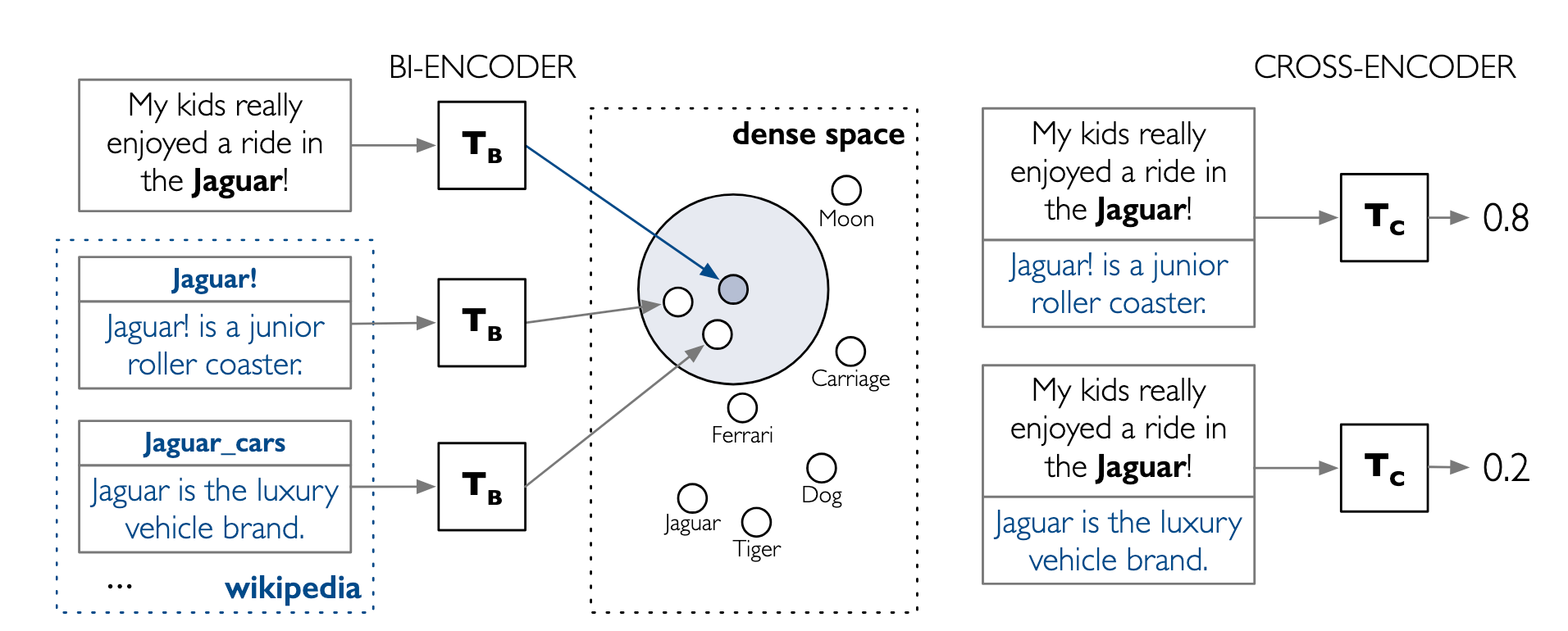 /// caption Wu, Ledell, Fabio Petroni, Martin Josifoski, Sebastian Riedel, und Luke Zettlemoyer. „Scalable Zero-Shot
Entity Linking with Dense Entity Retrieval“. EMNLP, 2020. ///
/// caption Wu, Ledell, Fabio Petroni, Martin Josifoski, Sebastian Riedel, und Luke Zettlemoyer. „Scalable Zero-Shot
Entity Linking with Dense Entity Retrieval“. EMNLP, 2020. ///
We resolve this by measuring the Contextual Isomorphism of their empirical textual envelopes \(T_A\) and \(T_B\).
Epistemic Proximity
Let \(T_A\) and \(T_B\) be textual envelopes containing injected entity markers. The dense candidate generation computes:
Because \(E_{\text{ctx}}\) projects vectors using the targeted \(\mathbf{h}_{\text{[ENT]}}\) token, this dot product measures the semantic similarity of the syntactic and contextual frames surrounding the two entities rather than the lexical meaning of their names.
Relational Reranking
High-scoring candidate pairs are mapped to the Cross-Encoder:
The multi-head self-attention layer computes the joint cross-attention matrix between tokens of \(T_A\) and \(T_B\). Because
[ENT] markers bound the target terms in both inputs, the self-attention mechanism computes empirical alignment
directly between the concepts' physical contexts:
This guarantees that Layer 3 global relationships are derived directly from the mathematical topology of their Layer 1 textual provenances.
Event-Driven Auditing & Telemetry
To inspect the empirical validity of these dense projections in real-time, the pipeline dispatches domain events to an observability sink (Langfuse):
EntityLinkingCandidatesRetrieved: Dispatched immediately following the MIPS Bi-Encoder step, capturing the list of candidates matched in vector space, their database identifiers, and similarity scores.EntityLinkingReranked: Dispatched after the Cross-Encoder computes the joint representation, capturing the candidate evaluated, the classification score, the acceptance status based on the threshold, and the parameter \(\tau\).
Related Documentation
- Formal Model: Formal Graph Schema (TheoryNet)
- Episodic Memory: Episodic Working Memory
- Pipeline Implementation: Pipeline Architecture
- Phase 2 Workflow: Entity Discovery Workflow
- Phase 4 Workflow: Entity Maturation Workflow
- Telemetry System: Event System & Telemetry