Theory-Nets, Posets & Topologies
This document establishes the structural topology of scientific theories within Episteme. It details how theories organize internally as Partially Ordered Sets (Posets) and Theory-Trees, how multiple theories connect globally into Theory-Holons, and how Hierarchical Leiden Community Detection extracts macro-level paradigms from the underlying graph.
Structuralist Theory-Nets as Posets
In the structuralist philosophy of science (Balzer, Moulines, & Sneed, 1987), the fundamental unit of scientific knowledge is not a linguistic sentence, but a theory-element:
where \(K\) is the formal mathematical core and \(I\) is the domain of intended applications.
A single complex scientific theory (such as Classical Mechanics or General Relativity) does not consist of a single isolated equation, but rather a structured hierarchy of interconnected theory-elements known as a Theory-Net (\(TN\)).
flowchart TD
    T0["Root Theory-Element (T_0)<br/>Fundamental Law Core (K_0, I_0)<br/>e.g., Newton's Second Law: F = m · a"]
    T1["Specialization T_1<br/>Gravitational Mechanics<br/>F = G · (m_1 · m_2) / r²"]
    T2["Specialization T_2<br/>Harmonic Oscillators<br/>F = -k · x (Hooke's Law)"]
    T3["Specialization T_3<br/>Frictional Systems<br/>F = -γ · v"]
    T11["Application Domain I_1<br/>Planetary Motion"]
    T12["Application Domain I_2<br/>Tidal Dynamics"]
    T21["Application Domain I_3<br/>Spring & Pendulum Clocks"]
    T0 -->|" Specialization (α) "| T1
    T0 -->|" Specialization (α) "| T2
    T0 -->|" Specialization (α) "| T3
    T1 --> T11
    T1 --> T12
    T2 --> T21
    T1 <===>|" Constraint (C)<br/>Invariant Mass Across Domains "| T2
The Specialization Relation (\(\alpha\)) and Bourbaki Structure Species
Theory-elements within a Theory-Net are ordered by a specialization relation (\(\alpha\)):
Drawing on Nicolas Bourbaki's concept of structure species, the specialization relation \(\alpha\) ensures that lower-level laws strictly inherit the conceptual framework of parent laws while adding specific constraints or mathematical restrictions (e.g., Hooke's law \(F = -k \cdot x\) restricting the general force function \(F = m \cdot a\)).
Structuring the intra-theory graph as a Partially Ordered Set (Poset) \((TN, \alpha)\) prevents circular definitions:
- Reflexivity: \(T_i \ \alpha \ T_i\)
- Antisymmetry: If \(T_i \ \alpha \ T_j\) and \(T_j \ \alpha \ T_i\), then \(T_i = T_j\)
- Transitivity: If \(T_i \ \alpha \ T_j\) and \(T_j \ \alpha \ T_k\), then \(T_i \ \alpha \ T_k\)
Theory-Trees (\(B (TN) = \{T_0\}\))
A mature, well-founded scientific theory forms a Theory-Tree: a connected Theory-Net (\(TN\), often denoted \(N\)) originating from a unique singleton root element \(T_0\):
Where \(B (TN)\) is the set of top-level minimal elements in the specialization poset. The root \(T_0\) embodies the fundamental invariant law (e.g., Newton's second law, Schrödinger's equation), while the outer branches represent specialized peripheral applications.
Structuralist Typology of Nodes and Edges
To map philosophical and scientific literature into property graph databases (such as Neo4j), Episteme classifies nodes and relationships using formal epistemic criteria:
Node Classifications & Sentence Typologies
Nodes are typed according to their propositional and epistemic status (Schurz, 2014; Balzer et al., 1987):
- Beobachtungssatz i.e.S. (Observation / Evidence Unit): Singular or localized statements containing exclusively empirical terms (\(L_E\)). In explanatory coherence models, these data units possess intrinsic acceptability (Data Priority).
- Empirischer Satz i.e.S. (Empirical Generalization): Statements containing logical and empirical concepts where all quantifiers have strictly empirical scope.
- Theoretischer Satz i.w.S. (Theoretical Hypothesis): Statements containing theoretical terms (\(L_T\)) or theoretical quantifiers. These represent core axioms or abstract hypotheses.
- Core Expansions (Mutable Auxiliary Hypotheses): Shiftable peripheral laws introduced to absorb anomalies without discarding the hard core (\(K_0\)).
Epistemic Sentence Classifications
To qualify these nodes further, we track their logical scope:
- Synthetic Contingent (Synthetischer kontingenter Satz): Statements that exclude possible empirical worlds, ensuring genuine empirical content (neither logically tautological nor contradictory).
- Essential Universal (Essentieller Allsatz): Unrestricted universal laws forming core principles.
- Existential Statement (Existenzsatz): Assertions of theoretical or empirical existence.
- Localized Statements (Lokalisierte All- / Existenzsätze): Spatiotemporally bounded empirical statements (e.g., "In experimental trial \(k\), measurement \(x\) observed").
Relational Edges
Edges capture deductive, structural, and coherence dynamics:
- Specialization Edges (\(\alpha\)): Directed vertical edges linking general laws to specialized variants.
- Constraint Edges (\(C, CL\)): Horizontal/lateral links crossing distinct application domains. Constraints demand that intrinsic properties (such as mass, charge, or utility preferences) maintain invariant values when identical entities appear in overlapping applications.
- Intertheoretical Links (Reduction & Entailment): Directed links between distinct theories, representing theoretical reduction (\(RED (p, E, E')\)) or conceptual imports.
- Deductive Entailment Relations:
- Erklärungsschema: Universal Law \(\wedge\) Singular Antecedent \(\Vdash\) Singular Consequence.
- Falsifikationsschema I: Singular Empirical Evidence \(\Vdash \neg (\text{Universal Law})\).
- Falsifikationsschema II: Existential Counterexample \(\Vdash \neg (\text{Universal Law})\).
- Coherence Links (Thagard's TEC):
- Excitatory Links (\(\mathcal{R}_{sup}\), weight \(\approx +0.05\)): Connect hypotheses that explain evidence or co-hypotheses that jointly explain a fact.
- Inhibitory Links (\(\mathcal{R}_{att}\), weight \(\approx -0.20\)): Connect contradictory or mutually competing hypotheses.
Dual Topological Scales: Theory-Nets vs. Theory-Holons
Episteme explicitly distinguishes between two topological tiers of scientific organization:
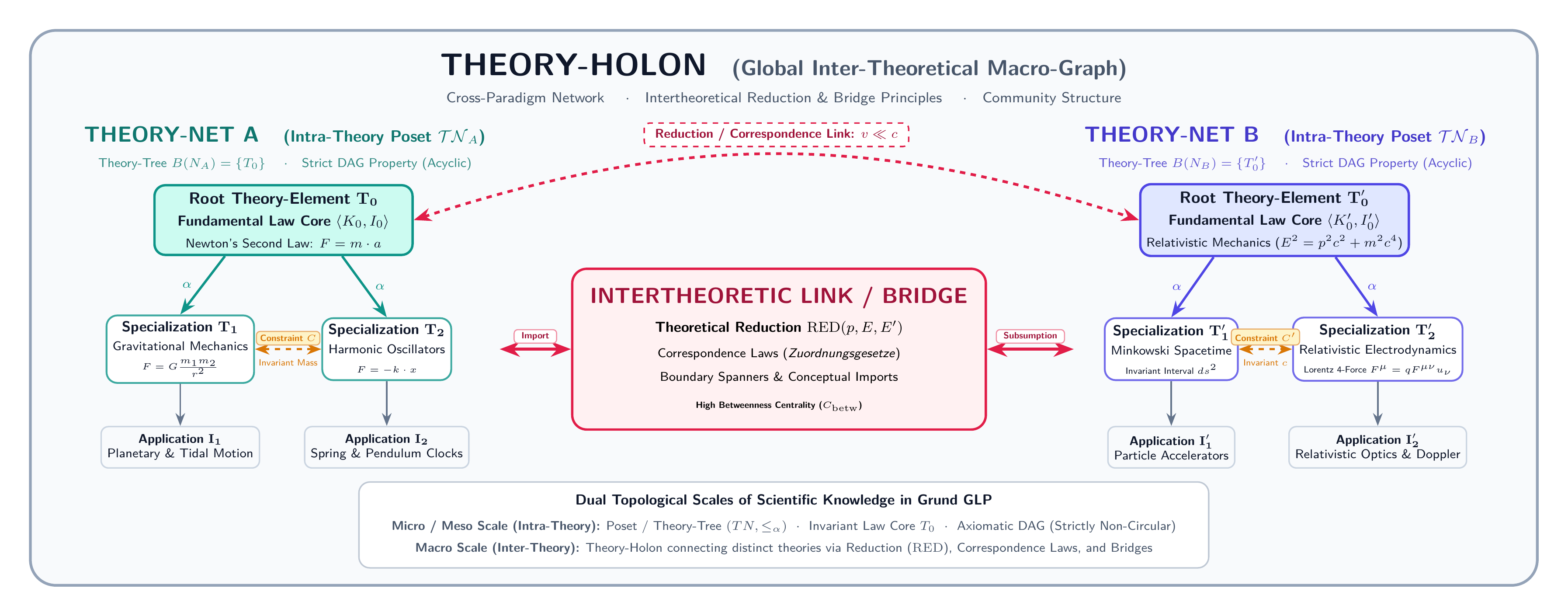
- Theory-Net (Intra-Theory Micro/Meso Graph): The internal, local structure of a single theory. Mathematically organized as a Poset or Theory-Tree. The DAG property ensures absence of internal circularity.
- Theory-Holon (Inter-Theory Macro Graph): The global, cross-paradigm network connecting multiple, distinct
scientific theories via intertheoretical links and community bridges. Its topology can be:
- Foundationalist: A directed acyclic graph terminating in foundational bedrock theories.
- Coherentist: A cyclical network of mutually supporting and interpreting theoretical frameworks.
Hierarchical Leiden Community Detection
While intra-theory structures follow formal deductive trees, cross-document scholarly literature forms dense, complex networks of competing arguments. To detect macroscopic paradigms, theoretical schools of thought, and conceptual clusters, Phase 5 of the pipeline executes the Hierarchical Leiden Algorithm (Traag et al., 2019).
Graph Projection & Modularity Optimization
During Phase 5b (Theory Fusion), the pipeline:
- Pulls all global
L2EntityandL3ArgumentComponentnodes along with their relationships from Neo4j into an in-memory NetworkX graph. - Builds an undirected weighted representation where edge weights represent aggregate relational confidence and argument support strengths.
- Optimizes network modularity \(\mathcal{H}\) hierarchically, avoiding the disconnected sub-cluster defects characteristic of older Louvain algorithms.
Three Hierarchy Levels
The Leiden detector partitions the theory graph across three semantic scales:
- Level 0 (Micro-Scale): Tight-knit argument units, individual claims, and their direct empirical grounding data.
- Level 1 (Meso-Scale): Conceptual subfields and thematic clusters (e.g., Epistemology, Ontology, Decision Theory).
- Level 2 (Macro-Scale): Overarching scientific paradigms and comprehensive schools of thought (e.g., Kantian Rationalism, Logical Positivism, Bayesian Decision Theory).
Graph Persistence
Identified communities are committed directly back to the Neo4j database:
- A
Communitynode is minted for each partition, annotated with its hierarchicallevel, modularity score, and generated centroid label. - Participating entities and argument components are connected to their parent community via
IN_COMMUNITYstructural edges.
Topological Node Centrality
Complementing community partitioning, microscopic node prominence is quantified via graph centrality metrics:
- Out-Degree Centrality (\(C_{\text{out}}\)): High out-degree identifies unifying core axioms and explanatory generators.
- In-Degree Centrality (\(C_{\text{in}}\)): High in-degree reflects evidentiary focal points or contested theoretical vulnerabilities.
- Betweenness Centrality (\(C_{\text{betw}}\)): High betweenness pinpoints Community Bridges—boundary-spanning concepts that mediate theoretical transfers between disparate disciplines.
- Eigenvector & PageRank Centrality: Quantify prestige and foundational importance by weighting connections by the centrality of neighboring nodes.
Related Documentation
- Formal Graph Schema: Formal Graph Schema (TheoryNet)
- Structuralist Benchmark (STNB): Structuralist Theory-Net Benchmark
- Epistemological Criteria: Epistemology & Wissenschaftstheorie
- Dense Alignment & Maturation: Dense Alignment & Grounding
- Topological Metrics: Theory Metrics: Structural Topology
- Terminology: Glossary